
AP Maths vs. A-Level Maths: What UK Students Choosing International Programmes Need to Know

More and more families across the United Kingdom are exploring international school programmes. Whether driven by relocation plans, dual-nationality aspirations, or simply a desire for broader academic horizons, the choice between different qualification systems carries real weight. In 2026, this trend shows no sign of slowing down.
The stakes run especially high for students eyeing STEM degrees. University admissions panels scrutinise mathematical qualifications closely, and picking the wrong pathway can narrow options at a critical moment. Structure, depth, assessment philosophy, and global recognition all vary dramatically between the two leading systems.
This guide breaks down exactly what separates AP Maths from A-Level Maths. It also explains how targeted tutoring support can bridge curriculum gaps, whether you're switching systems or juggling both simultaneously.
What Are the Core Differences Between AP Maths and A-Level Maths?
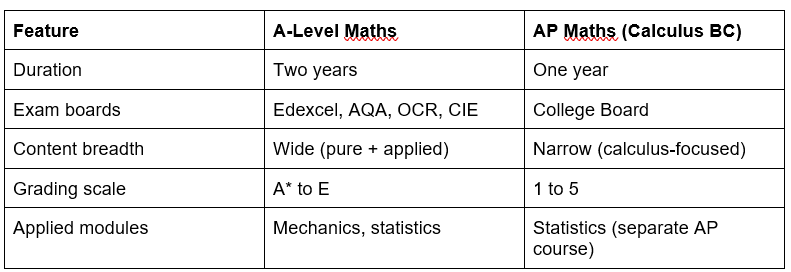
A math tutor familiar with both systems will tell you the same thing: these qualifications look similar on the surface but operate on fundamentally different principles. A-Level Maths spans two years under UK boards like Edexcel, AQA, OCR, or CIE, blending Pure Mathematics with Applied Mathematics (mechanics, statistics, or decision maths). AP Maths, administered by the College Board, splits into separate one-year courses: AP Calculus AB, AP Calculus BC, and AP Statistics.
The A-Level qualification covers broader mathematical territory within a single programme. Algebra, calculus, trigonometry, statistics, and mechanics all sit under one umbrella. AP Calculus, by contrast, zeroes in on calculus alone. AB handles single-variable calculus, while BC layers on parametric equations, polar coordinates, and series.
A math tutor familiar with both systems will tell you the same thing: these qualifications look similar on the surface but operate on fundamentally different principles. A-Level Maths spans two years under UK boards like Edexcel, AQA, OCR, or CIE, blending Pure Mathematics with Applied Mathematics (mechanics, statistics, or decision maths). AP Maths, administered by the College Board, splits into separate one-year courses: AP Calculus AB, AP Calculus BC, and AP Statistics.
The A-Level qualification covers broader mathematical territory within a single programme. Algebra, calculus, trigonometry, statistics, and mechanics all sit under one umbrella. AP Calculus, by contrast, zeroes in on calculus alone. AB handles single-variable calculus, while BC layers on parametric equations, polar coordinates, and series.
A-Level Maths: Breadth and flexibility
A-Level Maths covers pure topics (proof,algebra, calculus, trigonometry) alongside applied modules in mechanics andstatistics. Students can tailor module choices to match career goals, andthe two-year timeline allows for thorough, layered understanding.
Exam board choice matters too. CIE papers tendto push harder on problem-solving skills, while Edexcel follows a morestructured, predictable format. This distinction affects revision strategysignificantly.
AP Calculus and AP Statistics:Depth in specialisation
AP Calculus BC packs two semesters ofuniversity-level calculus into a single school year. The pace is relentless.Students who thrive under pressure often love it, but the intensity catchesmany off guard.
AP Statistics takes a completely differentangle, focusing on data interpretation, inference, and contextualreasoning rather than pure computation. Both exams use a blend ofmultiple-choice and free-response questions, scored from 1 to 5. Mostuniversities grant credit for scores of 3 or above.
How Do UK Universities View AP Maths Compared to A-LevelMaths?
A-Level Maths remains the gold standardfor UK university admissions, particularly for STEM degrees at Russell Groupinstitutions. Admissions tutors know the qualification inside out and trust itsdepth.
Top universities do accept AP scores, but theyset high bars. Cambridge, for example, requires AP Calculus BC at grade 5 asthe equivalent of A-Level Maths. Oxford and other elite institutions oftenexpect five or more APs at grade 5 for competitive entry. These thresholdsleave little room for error.
One significant gap stands out: A-LevelFurther Maths has no direct AP equivalent. Competitive STEM courses atImperial (Engineering) or Warwick (Mathematics) regularly expect Further Maths.AP students aiming for these programmes need to demonstrate equivalent depththrough other means.
American universities, meanwhile, stronglyfavour AP qualifications and often grant direct college credit. A-Levels carryweight in US admissions too, but applicants sometimes need to benchmark themagainst AP or IB scores. Choosing your qualification strategically dependsentirely on where you plan to apply.
Which Qualification Is Harder: AP Maths or A-Level Maths?
A-Levels earn a reputation for greater overalldifficulty, and for good reason. The two-year programme demands sustainedmathematical rigour. Exams emphasise proof-style reasoning and multi-stepproblem solving, where errors in methodology cost marks even when the finalanswer lands correctly.
AP Calculus BC presents its own challenge:sheer speed. Covering two university semesters of calculus in one academic yearleaves little breathing room. Students must develop procedural fluencyquickly while also handling applied problem-solving under timed conditions.
A-Level Further Maths sits in a league of itsown. Complex numbers, advanced linear algebra, differential equations, andtopics approaching university-level depth all feature prominently. No AP coursematches this scope.
So which system is harder? That depends on thestudent. A-Levels reward patience, depth, and methodical thinking. AP rewardsadaptability, speed, and the ability to absorb material fast. Neitherqualification is easy, and dismissing either one would be a mistake.
Key Differences in Assessment Style and Exam Format
A-Level exams consist of written paperstaken at the end of the two-year course. Everything rides on final performance,graded A* to E. Some modules may include coursework or practical assessment,though most boards have shifted toward exam-only formats.
AP exams follow a standardised structure,taken each May. Every paper blends multiple-choice questions (testing speed andaccuracy) with free-response sections (testing reasoning and explanation).Scores range from 1 to 5.
The philosophical difference runs deeper thanformat. A-Level marking rewards neat derivation and careful explanation.You might need to show why a trigonometric identity holds, step by step. APmarking focuses more on correct method and clear final answers.
Notation differences trip up studentsswitching between systems more often than you'd expect. British and Americanconventions diverge on function notation, integral presentation, and even theway logarithms appear. Small details, but they cause real confusion under exampressure.
How Can a Maths Tutor Help Students Navigate Between AP andA-Level Systems?
A skilled tutor spots specific curriculumgaps fast when a student moves between AP and A-Level systems. These gapsaren't always obvious. A student strong in A-Level mechanics might strugglewith the series work demanded by AP Calculus BC. An AP student might findA-Level proof questions completely unfamiliar.
Exam technique coaching makes a measurabledifference. A-Level students preparing for AP need practice withmultiple-choice pacing, where spending too long on one question destroysoverall performance. AP students tackling A-Levels need to develop the habit ofshowing full working and writing rigorous, method-mark-friendlysolutions.
Personalised sessions also address thenotation and vocabulary shifts between British and American conventions. Thesearen't trivial. Misreading a function notation or misinterpreting an integralboundary costs marks that have nothing to do with mathematical ability.
Beyond technique, one-on-one support buildsgenuine confidence. Maths anxiety spikes when students feel lost in anunfamiliar system. A tutor who understands both curricula can design a realisticstudy plan that prevents last-minute panic and keeps progress steadythroughout the year.
How to Choose the Right ProgrammeBased on Your University and Career Goals
Your target university system should drivethis decision. Planning to study in the United States? AP Calculus alignsdirectly with American admissions expectations and can earn you collegecredit before you even arrive on campus.
Planning to study in the UK or Commonwealthcountries? A-Level Maths remains the safer, more strategic choice. Admissionsteams recognise it instantly, and you won't face awkward equivalency questionsduring the application process.
For students genuinely undecided between USand UK universities, consider these options:
- Take A-Level Maths as your primary qualification and supplement with one or two AP exams
- Choose AP if your school only offers that system, but research each UK university's specific entry requirements early
- Pair either qualification with strong GCSE or IGCSE results to reinforce your profile
STEM-focused students should note a keydistinction. A-Level Further Maths signals depth to UK admissions panelsin a way no combination of AP courses can replicate. Multiple APs, on the otherhand, demonstrate intellectual breadth to American colleges.
Check each university's entry criteriaindividually. Generic advice only takes you so far. A tutor experienced in bothsystems can map out which combination of qualifications maximises your optionsacross different application pathways.
FAQ
Can I take both AP Maths and A-Level Mathsat the same time?
Yes, some international school students sit APexams alongside A-Levels to strengthen applications for both US and UKuniversities. The workload is demanding, and overlapping content sometimescreates confusion rather than reinforcement. A tutor can help manage bothcurricula efficiently, identifying where topics align and where they diverge.
Is AP Calculus BC accepted as equivalent toA-Level Maths by UK universities?
Many UK universities accept AP Calculus BCas an equivalent, but requirements vary significantly. Cambridge requires agrade 5 in AP Calculus BC for any course listing A-Level Maths as an entryrequirement. Always verify individual university policies, as some institutionsask for additional qualifications or higher thresholds.
Do I need a math tutor to switch fromA-Level Maths to AP Maths or vice versa?
It's not mandatory, but targeted tutoringeliminates common transition mistakes far more quickly than self-studyalone. Curriculum gaps, notation differences, and exam technique variations allbenefit from expert guidance. Even a handful of focused sessions can buildconfidence and smooth out the adjustment period.