
10 Emerging Digital SAT Strategies Every Indian Student Should Know in 2026

For Indian students, SAT preparation has long followed a familiar pattern: master concepts, solve large volumes of questions, and trust that hard work will translate into high scores. That approach worked reasonably well when the SAT was paper-based and predictable. The Digital SAT has changed that equation.
By 2026, the Digital SAT will no longer be “new.” What will still trip students up is preparing for it using methods designed for a different exam. The Digital SAT is shorter, adaptive, screen-based, and far less forgiving of inefficient thinking. It rewards strategic execution just as much as academic strength.
The strategies that follow are not shortcuts. They are adjustments that Indian students must make if they want their preparation to align with how the exam actually behaves.
1. Treat adaptivity as a performance variable, not a mystery
The most significant challenge for Indian students is the adaptive structure of the Digital SAT. Performance in the first module directly influences the difficulty of the second. This means early accuracy has disproportionate importance.
Many students continue to approach the test with a “warm-up” mindset, assuming they can afford early mistakes and recover later. In an adaptive exam, this thinking is costly. The Digital SAT demands sharp execution from the first question.
Preparation must train students to treat the opening module as decisive rather than exploratory. Digital mocks are essential here because they expose how early accuracy affects overall scoring outcomes.
2. Stop equating syllabus mastery with score predictability
Indian students are often academically strong. They understand grammar rules, algebraic manipulation, and data interpretation well. What surprises many is how unpredictable their scores feel despite this knowledge.
The Digital SATs application speed, prioritisation, and decision-making under time constraints. Mastery of content does not guarantee stable scores unless students also practise executing that knowledge efficiently on a screen.
The 2026 strategy is not about learning more content. It concerns learning to apply existing knowledge under adaptive pressure.
3. Reading strategy must change completely for screen-based passages
Many Indian students are trained to read slowly and thoroughly, especially in academic contexts. This habit becomes a liability in the Digital SAT, where passages are shorter and denser, and are followed by questions that reward precision rather than broad comprehension.
Screen-based reading alters focus and retention. Scrolling disrupts context, and re-reading wastes time. Students should learn to read with the question in mind, extracting only what is necessary to answer accurately, a process that requires targeted digital reading practice and post-test analysis to refine these skills.
This skill does not develop through book-based practice. It requires repeated digital exposure and post-test analysis to refine reading behaviour.
4. Grammar questions reward pattern recognition, not rule recall
Traditional SAT grammar preparation in India often focuses on the exhaustive memorisation of rules. The Digital SAT has shifted emphasis. Questions are framed to test whether students can quickly recognise which sounds are structurally correct in context.
Overthinking grammar questions often leads to mistakes. The most successful students develop an instinctive sense of sentence structure and flow, built through repeated exposure rather than rule recitation.
Timed digital practice trains this instinct far more effectively than isolated grammar drills.
5. Math strategy must prioritise speed and decision-making, not completeness
Indian students tend to attempt every math question, even when time is tight. This approach worked better in longer, linear paper exams. In the Digital SAT, selective skipping and rapid decision-making are essential.
Some questions are designed to consume time without yielding a proportional score. Learning when to move on is a strategic skill, not a sign of weakness.
Digital mock tests reveal which types of math questions drain time disproportionately and help students refine a high-return approach to the section.
6. Calculator fluency is now a core test skill
The built-in digital calculator is not just a convenience; it is part of the testing environment. Students who hesitate while using it repeatedly lose valuable seconds throughout the test.
Indian students often practise math manually and assume calculator use will be intuitive on test day. To build calculator fluency, students should incorporate regular digital practice sessions that focus on switching seamlessly between manual calculations and calculator use, ensuring they can do so efficiently during exams.
Only repeated digital testing builds this fluency.
7. Mental stamina matters more despite a shorter test
The Digital SAT is shorter than the paper version but more cognitively demanding. Adaptive difficulty maintains high pressure throughout the test. There is little room for mental drift.
Students who rely on long study sessions but rarely simulate full test conditions often struggle to maintain focus across both modules. Fatigue shows up not as exhaustion, but as minor lapses in judgment.
Full-length digital mocks train sustained concentration under real conditions, which is essential for consistency.
8. Score improvement requires analysing behaviour, not just answers
Many Indian students review mocks by checking incorrect answers and revising related concepts. This is incomplete. The Digital SAT demands analysis of how questions were approached.
Key questions students must ask include:
- Was time lost deciding rather than solving?
- Was accuracy affected by rushing?
- Did difficulty spike after a mistake?
Behavioural analysis turns mock tests into learning tools rather than score reports.
9. Consistency matters more than peak performance
A single high score is not predictive in an adaptive exam. Consistency across multiple tests is a far better indicator of readiness.
Indian students often fixate on achieving the highest scores rather than maintaining consistent performance. Digital preparation should aim to narrow score fluctuations by refining pacing, decision-making, and emotional control under pressure.
Repeated digital mocks create this stability over time.
10. Preparation systems must be digital-first, not paper-adapted
The most crucial strategy for 2026 is structural. Students preparing for the Digital SAT must train in environments that mirror the exam itself. Paper-based habits, PDF worksheets, and loosely timed practice create false confidence.
This is why serious SAT preparation today integrates digital testing from the start. Institutions such as AP Guru embed Digital SAT mocks, analysis, and strategy refinement throughout the preparation process rather than treating them as a final-stage activity.
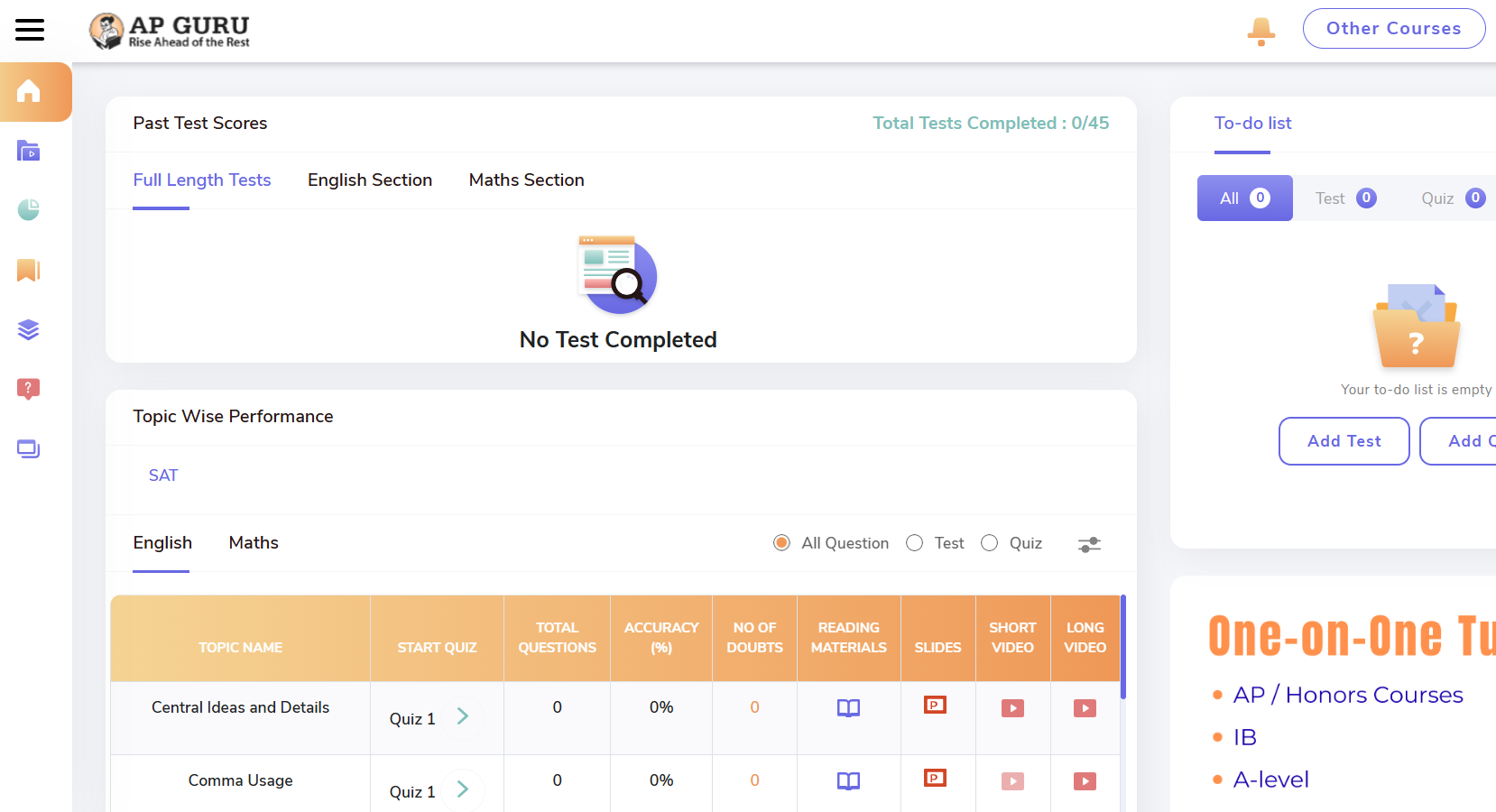
Students preparing through AP Guru practise directly in a digital testing environment using the student portal:
https://portal.apguru.com/
The portal is designed to ensure that timing, adaptability, navigation, and endurance are trained under real-exam conditions well before test day, emphasizing the importance of digital practice tools and platforms to simulate the actual exam environment.
Final perspective
The Digital SAT is not more complex than the paper SAT, but it is less forgiving of inefficient preparation. Indian students who continue to rely on traditional methods will feel prepared until the moment the exam begins.
In 2026, success will belong to students who train their performance, not just their knowledge.
Preparation that reflects the Digital SAT environment is no longer an advantage. It is a requirement.