
Directional Clues
Examples of directional clues:
- Higher than
- Lower than
- More than
- Less than
- Greater than
- Right of
- Above
- Reduces
- Same as
- Different from
- Goes up
- etc., etc., etc.
These little words or details - those that point to a direction in which the data is moving - are extremely important. If you obsess over these little details, you’ll have a much easier time on the science section.
Time to explain using an example from an ACT Science section: Experiment 1 different from Experiment 2 in which of the following ways:
A. More cichlids were observed in Experiment 1 than in Experiment 2
B. More cichlids were observed in Experiment 2 than in Experiment 1
C. More guppies were observed in Experiment 1 than in Experiment 2
D. More guppies were observed in Experiment 2 than in Experiment 1
Notice that every single answer choice contains the words “more than.” See how that’s going to come into play? It doesn’t matter if you understand the problem, have the right info, etc.
If you don’t pay attention to our “directional cue” - what is more than what - you are going to get the problem wrong. And when you’re stressed, rushed, and taking the real ACT, you will make mistakes here unless you arm yourself with a system to avoid directional mistakes. Let’s look at another example:
EXAMPLE 1:
Experiment 2
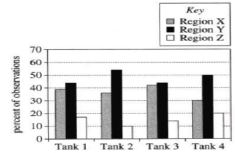
Tanks 1-4 were empties. Then Experiment 1 was repeated in every respect but the following: 4 guppies were added to the prey half of each tank, and the locations of each of the guppies was recorded at the time of each observation (See Figure 2).
Consider the results of Experiment 2 for the tank with the barrier through which both visual cues and chemical cues were transmitted. What is the order of the regions of the tank, from the region with the largest percent of observations to the region with the smallest percent of observations?
A. Region Y, Region X, Region Z
B. Region Y, Region Z, Region X
C. Region Z, Region X, Region Y
D. Region Z, Region Y, Region X
Solution: This problem is not hard, but it is insanely important that you figure out, precisely and with double-checking, in which direction everything is moving! These are your directional cues: Largest, then next smallest, then next smallest.
A says it’s Y, then X, then Z. So I look at Figure 2. Y, the black bar, is always the biggest. Z, the white bar, is always the smallest. X is always in the middle. And ta-da! We have our answer! Check the other choices out if you don’t believe me. A is the right answer.
I am sure that many of you must have picked answer choice C just because they went in the wrong order (smallest to biggest) and didn’t take the time to label their directional cues.
You might say to yourself, “yeah, yeah... that’s pretty obvious.” But here’s the thing: during your test, your mind will be moving at a thousand miles a minute, and when you are stressed or hurried, details are the first thing that go out of the window. Therefore, your job is to ruthlessly and consistently check every single directional cue you see in every question and every answer choice.
Countless studies have shown that when people have to make a decision in a hurry, they stop paying attention to details and start to rely on their previous idea of the “big picture.”
For instance, if you’re about to get in a car crash with a car heading toward you, your brain goes to the “big picture” activity it has on file for “thing heading towards me quickly, SWERVE” You might not notice the fact that there’s a cliff on either side of you or that the other car is beginning to swerve itself...etc. etc. When you’re stressed and hurried, you don’t think about details. This is how the ACT science section breads its butter.
I can’t even tell you how many times I’ve sat down with students to review their performance and heard something like this: “Oh man...I can’t believe I picked C! It says more than, but the graph is moving in the opposite direction! It’s less than! Duh!”
OR
“Wow...I can’t believe I picked B. All the volcanoes erupted at lower altitudes!” “What! Ugh I’m so stupid, I can’t believe it. Obviously it’s F, not H...the line is moving down, not up!”
You get the picture.
Failing to notice directional cues isn’t “some silly mistake that you make.” And trust me...if you don’t look out for it, you will make it all the time. You’ll be rushed, you’ll be stressed, and you’ll stop paying attention to arguably the most important word in every single answer choice.
Fortunately, there’s an easy way to solve this problem: If you want to move through your ACT science section rapidly, without making any “silly” directional errors, there’s a simple, straightforward formula that you can use on every problem.
Circle, and then repeat, every single directional word in every question and answer that you read. You want to document everything like a five-year-old. Act like you’re that guy from the movie “Momento” who can’t remember anything for more than two seconds. It’s not enough to just read the directional cues - you need to write or repeat them accurately, and make them stare you in the face.
For EXAMPLE: In Experiment 1, in which of the tanks was the guppy able to see the cichlid?
A. Tank 1 only
B. Tanks 2 and 4 only
C. Tanks 3 and 4 only
D. Tanks 2,3 and 4 only
Annotations: Guppy see Cichlid or Guppy -------> cichlid.
Don’t be afraid to draw! Visual cues help. I want to be 100% sure that I’m talking about the Guppies and what they can see, remembering that I don’t care what the Cichlid see. Again, sounds obvious, but students screw this up very often.
By the way, this isn’t just some random, piddling detail on a few science problems - these “directional” cues are in practically EVERY science problem!
Make sure you invest the time to label the graphs, figures, charts, axis, etc. The devil is in the details.
Direction on this test is everything. Once you start using them effectively, you will realize how ridiculously common directional errors really are.