
Speed is Everything

There was a joke we commonly told while I was obtaining my engineering degree: “Mathematicians calculate π as 3.14159..., Engineers calculate π as 3.14, and Scientists calculate π as approximately 3.”
Don’t be a mathematician, be a scientist.
At the onset of this chapter, I want to establish an overall rule that you’ll be using on every science problem that you answer: If you cannot solve a science problem in under a minute, leave the question. JUST LEAVE IT.
Pick an answer choice at random from the ones you have remaining (if you’ve been able to eliminate any) and just move to the next question.
Remember something: Every single ACT Science problem, hard and easy, is worth one point. That insanely easy problem you solved right up front? One point.
That ludicrously complicated chemistry problem toward the end of the section that you feel like you need a PhD to answer correctly? One point.
This is very important to understand for one key reason: The ACT doesn’t reward you for “sticking it out” and “getting that tough answer.” Instead, they mercilessly punish you for wasting time.
In total, you have 35 minutes, or 2100 seconds, to complete this section. That means you have 52.5 seconds for each problem. Every single time you spend more than 52.5 seconds on a problem, you’re eating up time that you need to solve other problems.
Fortunately, the way to avoid this mistake is very, very simple: If you’ve spent what feels like a minute solving a problem, and you’re not about to solve it, just leave the question.
I don’t expect you to look at your watch on every problem, or time yourself on every problem. That would be inefficient, distracting, and stupid. Instead, you need to develop a sense of how long you’re taking on each problem. If you start to get the idea that you’re taking too long, you probably are.
By the way, one more point on this: Do not plan on going back to problems later on in the section. EVER.
You will very, very rarely have any real time left at the end of a science section. If you do, you won’t have the context necessary to really launch into a problem that you already attempted once. Aim for a smooth, evenly timed performance through the whole section, ending up with about one minute left at the end.
So, without further ado, let’s discuss a specific tactic that will enhance your accuracy: The questions and answer choices are everything.
When it comes to ACT science, I can’t emphasize this enough: the only thing that matters are the questions and the answer choices.
The key to nailing the ACT Science Exam is to not read the passage completely before looking at the questions. This is because there is a relatively large amount of information in the passage that you won’t be asked about, and so reading and analyzing it before looking at the questions is a waste of time.
Instead, use the questions to direct you to where in the passage to look. Many of the ACT Science questions include in the question stem where to find the answer, giving you an instant “homing signal” to where to look to solve the problem (i.e. “In Figure 4, ...”). Even if they don’t explicitly contain a line or figure to reference, the question stem will contain keywords that can direct you quickly to the relevant sections of the passage.
By using these markers to direct you through the passage, you can go straight to the most important, valuable parts and skip the paragraphs and figures that are never asked about.
Let’s work through an example. The aim is to narrow down to list the specific pieces of info required to answer the questions and eliminate all the answer choices that don’t match what you’re looking for.
EXAMPLE: According to study 1, which rhibase recombinant structure results in the largest increase in overall oxygenation % of a shtank?
A. W
B. X
C. Y
D. Z
You don’t need to know what rhibase is, what a recombinant structure is, what overall oxygenation % is, or even what a shtank is.
You just scan study 1, find a graph/table that contains different rhibase structures labeled as W, X, Y, and Z and oxygenation %. Then see which one has the highest number for oxygenation %.
So if a table contains structures G, H, B, T, L, W, X, Y, and Z, you already know that you only care about the last four. Who cares about the others? Isolate those, see which number is the biggest, pick it, and MOVE ON.
What makes these problems harder than it should be is that people very rarely focus on the differences between answer choices, and instead try to find the right answer overall.
One exception to this rule is the Conflicting Viewpoints passage, which you should skim in its entirety before looking at the questions (more on it in the later chapters).
Act like a Race Horse
Generally, one of the biggest issues for students is that they can’t seem to find the right evidence in time to answer a science question. At first, this seems like a very general, very intangible problem. How could you possibly fix it, other than by simply “getting faster?”
Have you ever seen a racehorse wearing blinders? You know the little shields on the sides of their eyes that prevent them from seeing anything with their peripheral vision, and forcing them to look straight ahead at the track in front of them.
They don’t just wear those because they look fabulous - they wear them because when they aren’t dealing with distractions, they run much faster. After all, speed is the only thing that matters to a racehorse owner.
Why am I talking about horse racing? Because the best way to move faster on the ACT science section is by putting on blinders.
In other words: the better you get at ignoring irrelevant information and focusing only on the EXTREMELY limited amount of information you need to, the faster and more accurate you’ll become.
You already know the basic drill:
- Read the problem
- Check out the answer choices
- Find the relevant information in the passage
- Use it to eliminate the wrong answer choices
- Stick with the “last man standing”
For instance, on a problem that asks: “How many times did the volcano erupt in the 1900s?” If there’s a graph that shows “volcanic eruptions in the 1900s” with a giant spike for each eruption....duh.
If the problem asks, “According to figure 2, which of the 8 trials produced the fastest average speed?” Just look at figure 2, compare the four trials presented in the answer choices, and pick the one with the highest average speed. We’re done here.
Unfortunately, the problems aren’t always this easy. The thing that makes ACT science difficult is that sometimes, the path toward the proper evidence isn’t quite clear. Sometimes, we need to make inferences or assumptions based off the evidence, and no amount of scanning will help us. Other times, the information we need isn’t even in the passage at all (for instance, on the “random scientific information” problems), and we risk wasting minutes looking for it if we’re not careful.
At times, it seems like there’s just too much information to collect, and it’s practically impossible to grab all of it in the 52.5 seconds we’re given. And in all cases, it’s pretty darn ambiguous - where do we look, how deeply, and how do we know when and why to do it?
It could all make you tear your hair out unless you realize one key thing: Knowing what you DON’T know is one more important ACT science skill!
For example, If you’re looking for “average height of the giraffes,” and you can’t seem to find it anywhere, the key skill is to realize that either:
- It’s not listed, and you need to make do without it
- It needs to be inferred from another piece of information
These are the only two possibilities.
Every single ACT science “research” task boils down to either realizing that the information can’t be found, or figuring out where the breadcrumbs lead to.
For instance, let’s try the following problem: Based on Table 2, which of the following years was hottest in Atlanta?”
A. 1998
B. 1999
C. 2000
D. 2001
You look at Table 2, and discover that all Table 2 references are caterpillar population for those years! What in God’s name!?!?
The caterpillar populations for all of those years are:
- 1998 - 30K/Square Mile
- 1999 - 45K/Square Mile
- 2000 - 12K/Square Mile
- 20001 - 85K/Square Mile
Well....it looks like we’ve hit a dead end. Clearly, this problem is impossible to solve. Or is it? It’s actually quite easy to solve if you put on your blinders.
Be the race horse. Have a singular, ridiculously focused goal in mind. Remember: all you want is “hotness in Atlanta.” All you have right now is caterpillar population in Atlanta.
So, try to figure out if caterpillar population has something to do with heat? Your goal is to see if you can tie the two together. So you scan the other tables, figures, and graphs, etc., and Eureka!
Another graph has a line showing an inverse relationship between heat and caterpillar population. In other words, the hotter it becomes, the fewer caterpillars there happen to be.
Woooo! This means that the year with the fewest caterpillars is the hottest year. So the answer is C) 2000.
If you hadn’t found this information in a graph, table, or other similar figure, you could have quickly scanned the passages to see if the word “caterpillar” was anywhere to be found. If you didn’t see any of that anywhere, then there is no possible way to answer the question using the evidence at hand. You need to use inference, scientific knowledge, or common sense to find your solution. After all - the trail of breadcrumbs has ended!
If you follow every lead, but there is nothing waiting for you, then the problem must be solved without passage-based evidence. This means that you’ll stop wasting time looking for evidence or information that doesn’t exist.
Scan for Keywords
Another key strategy that helps save time and improve accuracy on the ACT Science exam is looking for specific keywords when examining the answer options.
Some questions won’t have a note for which specific line(s) and figure(s) you need to look at to answer them. In these cases, it’s most efficient to quickly identify one or two keywords from the question to use as mental “search terms” when looking through the passage to find the answer.
Another great time to look for keywords is when choosing an answer option. Let’s say you were directed by a question stem to a particular figure - in this case, it can be most efficient to try to “match” keywords between the figure and answer options to quickly identify the correct answer.
Finally, a very important time to use keywords is when reading and answering questions on the Conflicting Viewpoints passage. First, when skimming the passage be sure to be on the lookout for words that jump out to you as particularly important - variables, trends, cause-effect relationships, etc. Furthermore, after you’ve read a question stem and are trying to search a passage for relevant information as quickly as possible, having a keyword or two in mind will help your brain quickly recognize the relevant section(s) of the passage.
Example 1
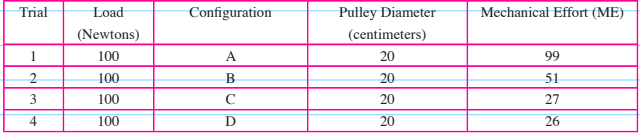
The length of the cable required to lift a load in a pulley system increases proportionately when the difference between the load and mechanical effort increases. According to Trials 1-4, the shortest cable would be needed for
A. Configuration A
B. Configuration B
C. Configuration C
D. Configuration D
Solution: This is an example in which keywords can be used when looking back at the figure or table indicated to search for the relevant information. When we are reading the question, the words that should stand out to us are difference, length, load, and mechanical effort.
Since the question is asking about which configuration would lead to the shortest length, we know that we’re only going to need to look at “load” and “mechanical effort” - specifically the difference between them. Since it’s clear from looking at the table that all of the loads are the same, we only need to look for the mechanical effort closest to 100 to find our answer (A).
Compare and Contrast
Another important skills on the ACT Science exam is the ability to quickly and confidently assess similarities and differences between experiments, figures, and trends.On the conflicting viewpoints passage, it will be critically important to pick up on similarities and differences between the two scientists’ opinions as you skim the passages the first time.
Example 2
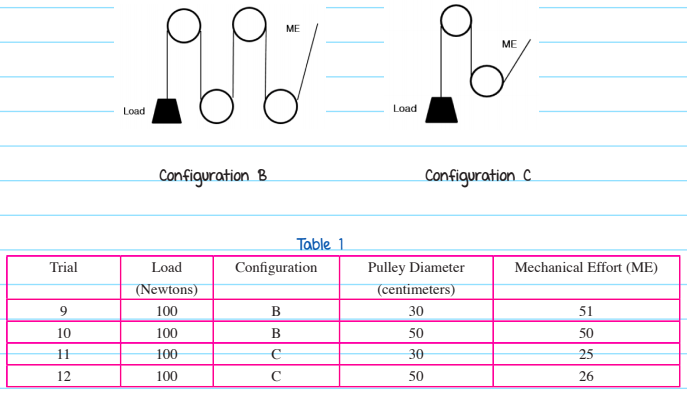
The results of Trials 9-12 are consistent with the hypothesis that the mechanical effort required to lift a load of a given weight in a pulley system is dependent upon the
A. Arrangement of pulleys
B. Shape of pulleys
C. Number of pulleys
D. Diameter of the pulleys
Solution: First, let’s examine trials 9-12 to compare and contrast them to see what’s being changed. As we can see, the load is staying the same, but the pulley configuration and the pulley diameter are being changed.
For trials 9 and 10, even though the pulley diameter is being changed, the ME stays constant. For trials 11 and 12, the ME also stays the same for two different pulley diameters. Thus, it should be clear that pulley diameter doesn’t impact ME, but pulley configuration does. However, note that “Pulley Configuration” is not one of the options – instead, we need to look at the two pulley configurations. Configuration B has only 2 pulleys while Configuration C has 4 pulleys. Therefore, C is the right answer.
Avoid Justification
This strategy has to do with justifying answer options as being correct even though there might be something slightly off about them or they aren’t quite saying what you think is the correct answer.
When the ACT Exam writers get together to write the exam and generate answer choices, they want to populate the incorrect options with things that seem as plausible as possible, to make it more difficult to distinguish the correct answers from the incorrect answers.
As a result, it’s very dangerous to rely on an answer seeming “close to correct” or “almost right” - these could very well be the close-but-incorrect answer options that were placed there just to trick you!
Remember, there is just one correct answer for each question, and that answer must be totally and completely correct - it can’t be partly correct and partly incorrect, or “almost” the right answer.
Example 3
Scientist 1:
There is no apparent practical value to the figures in the Nazca Lines. For example, they do not channel water or act as roads leading to a particular destination. They cannot be considered ornamentation, since they are too large for the images to be made out from any known Nazca settlement. They are not an idle creation, since it would take a concerted effort of many individuals to displace the amount of rock removed from the lines. Most of the removed rock is not present near the lines, but was transported elsewhere. Therefore, it can be assumed that the geoglyphs were created for religious purposes. There is evidence that the Nazca worshipped nature, including mountains and water. The images are visible from the top of a nearby hill, which might indicate a link with a ceremony related to mountains. Furthermore,
the stylized images represent creatures from the natural world, so might even be images of native deities. Though the meaning is obscure, the purpose of such a large-scale project would certainly be one related to the religious values of the people who made it.
Scientist 1’s viewpoint indicates that ornamentation
A. must have practical value
B. is meant to be easily visible
C. would not have spaces of removed rock
D. is only constructed by groups
Solution: The line in the passage that is directly relevant is “They cannot be considered ornamentation, since they are too large for the images to be made out from Nazca settlement”.
We can see how answer choice A might fit with the statement - after all, not being visible from any of the Nazca settlements seems pretty impractical to the people who made them. HOWEVER, justifying this answer would be wrong. We don’t have any direct proof. Considering answer option B, on the other hand, we find it possible to directly prove that from the quote above: “meant to be easily visible” is directly contradicted by “can’t be made out from any known settlement”.
This example illustrates the difference between an answer option that could be justified as correct and one that can be shown to be correct, using the actual text as a guide.
Mimicking Real Test Conditions
All the material knowledge and strategic mastery in the world won’t help you if you can’t apply your knowledge to real tests under realistic, timed conditions. And when it comes to the ACT, speed is everything.
Whenever I look at my students’ ACT score reports, they often usually look like this (R being “right,” “X” being “wrong): RRRXRRRRRRRRRRRRRRRRRRXRRRRXRRRRXXXXXXXX
Put another way: they weren’t having too much trouble getting correct answers - they just weren’t reaching the entire last passage of the section (or more).
When it comes to all four sections of the ACT, there’s something you need to understand: It’s better to answer 100% of the questions with 90% accuracy than it is to answer 80% of the questions with 100% accuracy. If you don’t finish your sections, you won’t get a high score.
It’s just impossible.
Therefore, it’s important to learn how to force oneself to finish the science section every time, whether one likes it or not. From now on, when you work on your science, you need to be under extra time pressure so that the real ACT feels like a vacation in comparison.
Here is how this is going to work: Use a stopwatch
Work through an entire science section from the homework section of this book, but give yourself only 45 seconds per problem. For the conflicting viewpoints passage, give yourself, at most, 90 seconds to read the passage. Get through the entire section this way, never taking a break between problems, and never allowing even one second more than the time allotted.
At first, this might be extremely stressful and weird. But here’s the thing: your brain is capable of incredible things when you don’t give it any choice.
If you give yourself two minutes per problem, your brain will gladly use all of it. But when you force your brain only 40-45 seconds/problem, you’ll quickly realize that the same steps are just as easy to complete in 1/4th of the time, so long as you push yourself.
Once you have completed the section, check the answer key and see how you performed. Review all the wrong answers using the explanations. At this point, you can take your time.
It does not matter how hard the problem is - you’re going to glance at your watch before each problem, go through the above checklist, and never take more than 45 seconds. If you could not finish the problem - it doesn’t matter. Pick the best answer you can come up with at this point, and then move on.
When you’re finished, ask yourself how you could have found information more quickly, why you made the errors that you did, etc. After the insane timing bonanza, you can relax and really think things through. But while you take the section, you’ll be working under ludicrous time pressure.
Why does this works so well?
During your actual test, it would be extremely impractical to have you staring at your watch constantly. Which is why, during your practice sections, you need to get used to the feel of time. Your brain needs to learn exactly what forty five seconds feels like. You need to build such an internal mechanism for time pressure that when you take your actual test, looking at your watch will be unnecessary. This only comes through practice.
This is also why I’m advocating you take less time than you’re actually allotted per problem. Rather than being “shocked” by the rigors of the test, and not finishing your sections, I want you to finish each section wondering whether something might have been wrong. Did you miss a question? Why is there still so much time?